
Charles Henry Moran was born on February 19, 1901, in New York. His father, Charles Henry Moran, was 46 and his mother, Elizabeth McAtee, was 44. The 1905 New York State Census records the family living at 481 Fifth Avenue, Troy, New York. Charles Moran lived with his six sisters, ages 6-17 and his older brother, age 22. His mother, Elizabeth McAtee Moran, died that same year on September 22, 1905.
The 1910 US Census shows Charles Moran still living in Troy at 321 Fifth Avenue. His father still runs a saloon. His six sisters and aunt are living with the family. His older brother, John has moved out. Four years later, in 1914, his father, Charles Henry Moran died. The 1915 State Census lists Charles Moran living with his sister, Mary, who works as a stenographer. Charles is attending school.
The 1920 US Census lists Charles Moran living at Clifton Terrace in Weehawken, New Jersey. He is living with his sister, Mary C. Moran, age 30, who is the head of the family. Also living at the same residence are his sisters Elizabeth (age 25), and Rosann (age 21) along with his aunt, Emma McAtee (age 58). His sister Sarah died on March 25, 1923, in New York.
The 1920 Yearbook for Notre Dame University shows Charles Moran as a member of the Kentucky Club. The 1923 City Directory for Albany New York lists Charles Moran as a student living at 564 Park Avenue in Albany. His sister Elizabeth Moran is also a resident of the same address. Her occupation is listed as a nurse.
His obituary in The_Daily_Times, Mamaroneck, New York, dated Tuesday, April 8, 1952, states Charles Moran graduated from Notre Dame University in 1925. He then went to work for the New York Graphic after graduating from college. Wikipedia notes that the nickname for the paper was the porno-Graphic. The paper had a reputation for trashy articles. The paper had such a low reputation that the New York Public Library did not collect the paper in its archives. The Brooklyn Daily Eagle published an article on July 2, 1932, noting that The Daily Graphic filed for bankruptcy.
The 1925 State Census shows Charles Moran living as a boarder on 89th Street in New York City. His occupation is “newspaper business.” Four years later, he marries Mildred Agnes Brotzman Hardenbergh on October 25, 1929, in Manhattan, New York. A little over two years later, a son was born in 1932 and a daughter in 1934.
The 1940 US Census shows Moran and his family living on West 72nd Street since at least 1935. He is working as a magazine editor making over $5,000 per year. Mildred is at home with the children and is not seeking employment.
Moran’s draft card, dated February 15, 1942, lists his address as 3215 Netherland Avenue, Bronx, New York. Another address is written above listing the Hotel Alamac. Both have a line drawn through them in pencil. The person who will always know his address is Mildred A. Moran at 3215 Netherland Avenue, Bronx, New York. Street & Smith at 79 Seventh Avenue, New York is his employer.
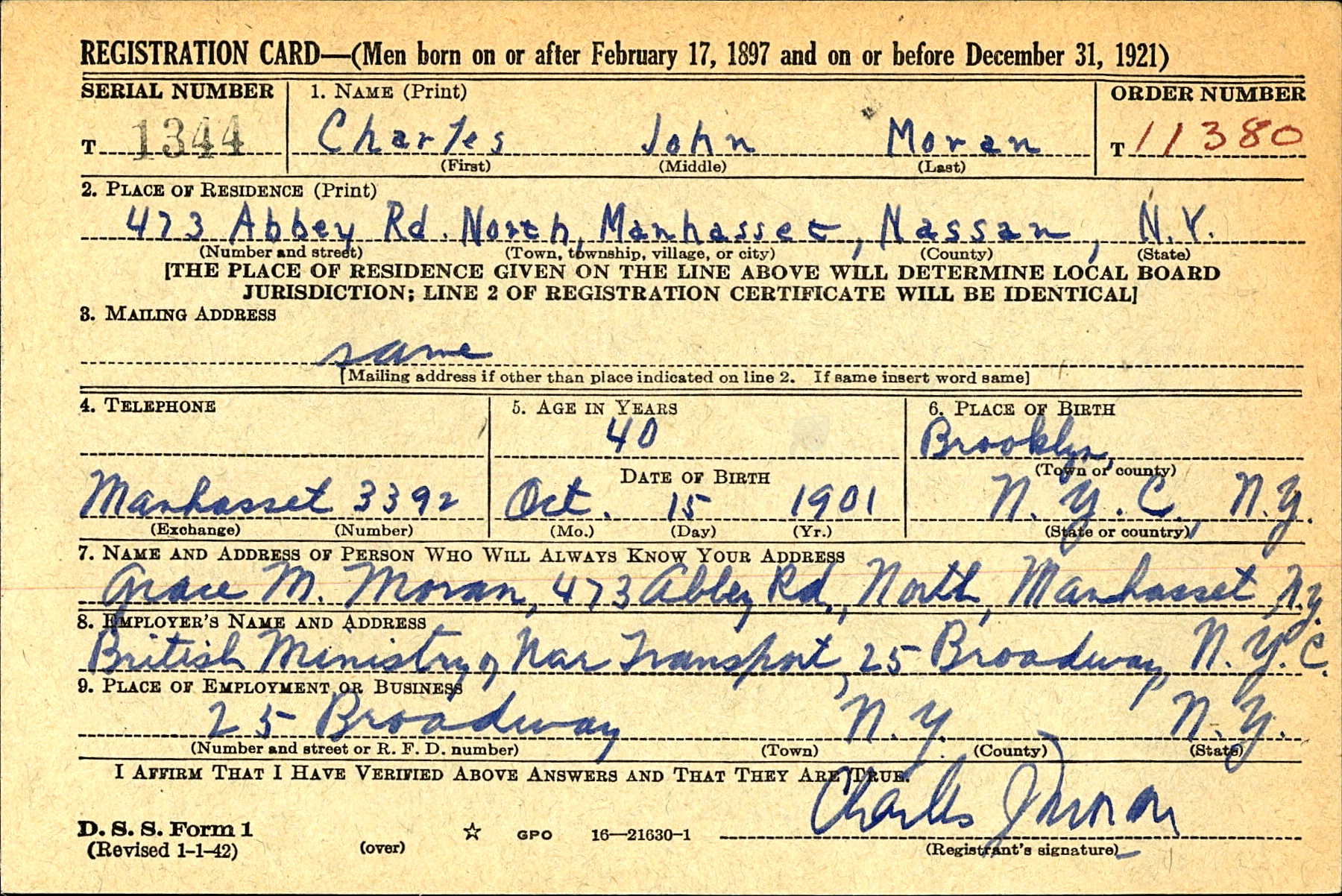
Click for larger image
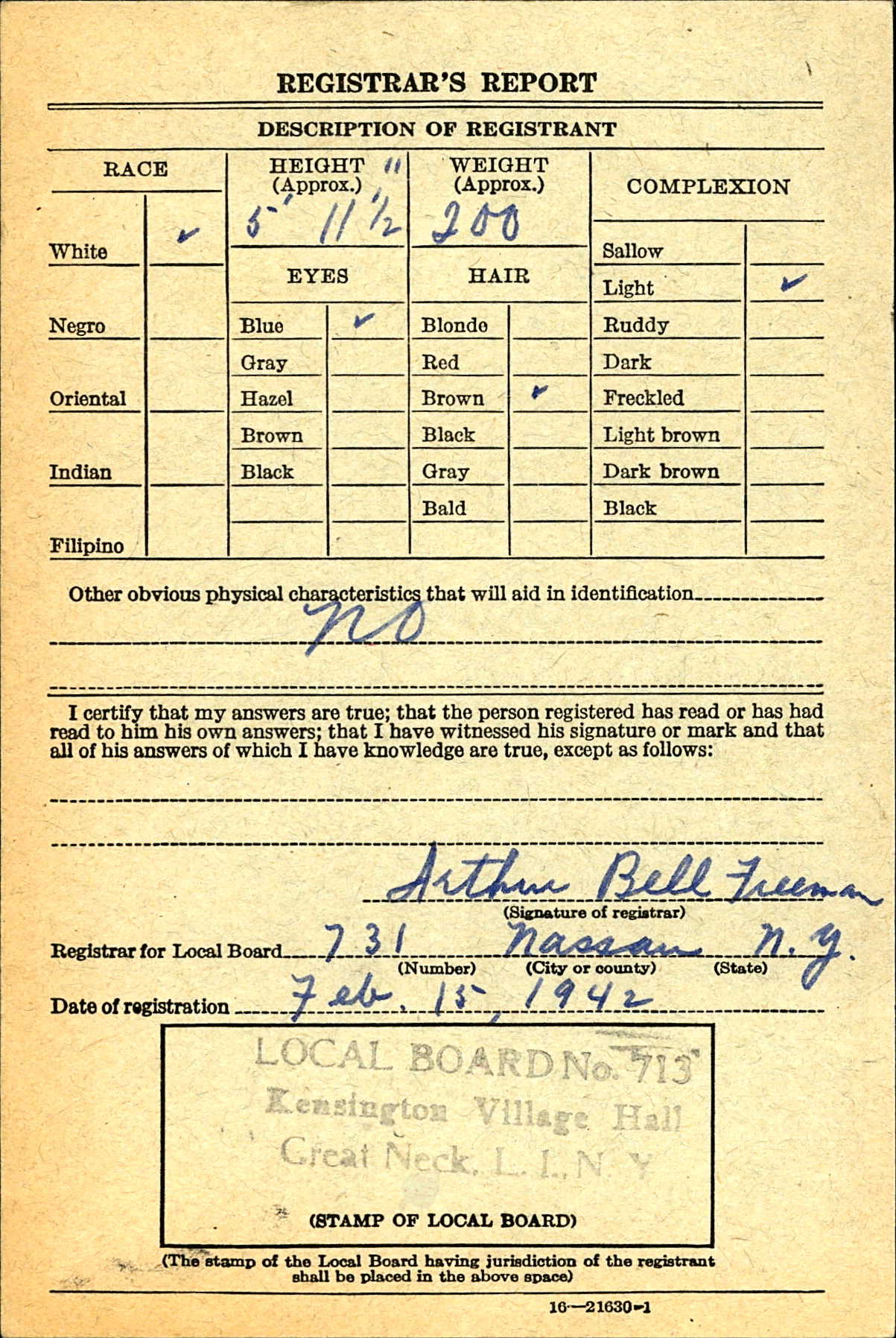
Click for larger image
Charles Moran’s wife, Mildred died on January 28, 1943, of pneumonia. She was only 44 years old. They had been married 13 years. She had previously worked at the Brooklyn Eagle and the New York Graphic. She was living at the Hotel Alamac in Manhattan at the time of her death. The obituary from The Brooklyn Daily Eagle mentioned that Charles Moran was a sports editor for Street & Smith. A short commentary in The Courier News, January 30, 1943, stated that Charles Moran formerly worked at the Newark Star-Eagle.
July 16, 1943 – Lester Dent writes Charles Moran, Editor of Doc Savage Magazine, about a letter he received from John Nanovic. Dent writes “I have a note from John Nanovic saying that chop, chop, off came his editorial head.” Dent is probing Moran and trying to get a feel for his expectations on the Doc Savage stories and the process. Dent notes he has a story that is almost complete and that he has one last plot left approved by Henry Ralston. Dent professes to be apolitical on office politics.
July 19, 1943 – John Nanovic writes Lester Dent about his current plans. He tells Dent he will try to go into advertising and will only return to the pulps if he has no alternative. Nanovic describes Charles Moran as the “big shot” type. Nanovic notes that Moran does not really care for the pulps. Nanovic advises Dent to go along with Moran while studying him and learning his mannerisms and motivations. He thinks Dent will find working with Moran pleasant.
July 19, 1943 – Charles Moran writes Lester Dent about John Nanovic. Moran states he knows of no politics involved in the termination. Moran notes that Nanovic had two monthlies while he had a comic and four annuals. Moran writes that someone was going to lose their job. Nanovic had the smaller section, so it was him. Moran notes that Street & Smith has been chopping on the pulps for a while. He believes that it will continue until a small staff can manage the pulp magazines. Moran notes he read Doc Savage stories over the weekend and likes the style. Moran also mentions being extremely busy with his magazines at the time and his eleven-year-old boy just had an emergency appendix operation. Moran tells Dent to send his Doc Savage story in as it is too late to make any real changes. He closes stating his intentions are to change little regarding Doc Savage.
July 13, 1943 – Less than six months after the death of his wife, Charles Moran marries Rosalind Packer, age 37 in New York City.
August 16, 1943 – Charles Moran writes Lester Dent with thoughts on adventure stories. Moran wants stories that move the reader into experiences not found in real life. Then he turns around and complains Doc Savage stories are fantastic and unplausible. Moran talks about the story Dent is working on (“Death had Yellow Eyes”) and says too many gadgets spoil the adventure. Moran desires more suspense in the stories and notes “One-Eyed Mystic” lacked suspense. He further criticizes the story and ends with stating Doc Savage should be a “plausible man.” Moran states these ideas have evolved from several discussions at the Street & Smith office. Moran closes his letter admonishing Dent that Doc Savage should not be a superman and to use as few gadgets as possible.
This is certainly in conflict with the adventures of the Invincible Doc Savage over in the comics. This was around the time when Doc Savage had a magic cowl and could fly.
August 25, 1943 – Charles Moran writes to Lester Dent concerning a trip by Dent to New York. He talked with Henry Ralston who approved the idea but stated Dent must pay his own expenses. Moran wants to have a meeting with Dent to go over Doc Savage.
September 24, 1943, Wednesday – Charles Moran writes Lester Dent about the “Skull Shoal” outline. Moran immediately tells Dent that it will take too long for the story to develop. He suggests dramatically condensing the first two chapters. Interestingly, Moran notes that it has been frequently mentioned in past issues that Doc Savage is heavily credentialed by the Navy and War Department. Moran suggests putting Doc is on the ship as a government representative is the best path.
Moran also comments on “According to the Plan of A One-Eyed Mystic” and notes that current censorship restrictions forbid the mention of RADAR. Moran needs a rewrite on the ending by Wednesday.
Moran’s comments on RADAR are bizarre considering “The Secret of the Su” hit the newsstands the same day his letter was dated. That issue’s “Editors Page” devotes several lines to RADAR. The subject is introduced in the following fashion: “Radar! The scientific discovery of the age. The miracle weapon. Who has not heard of this astounding invention for radio detection and ranging? An instrument that not only warns of the approach of enemy aircraft and surface fleets but reveal their position as well.” The text goes on to reveal that RADAR is the subject of the next Bill Barnes story, “The House of Sudden Death.”
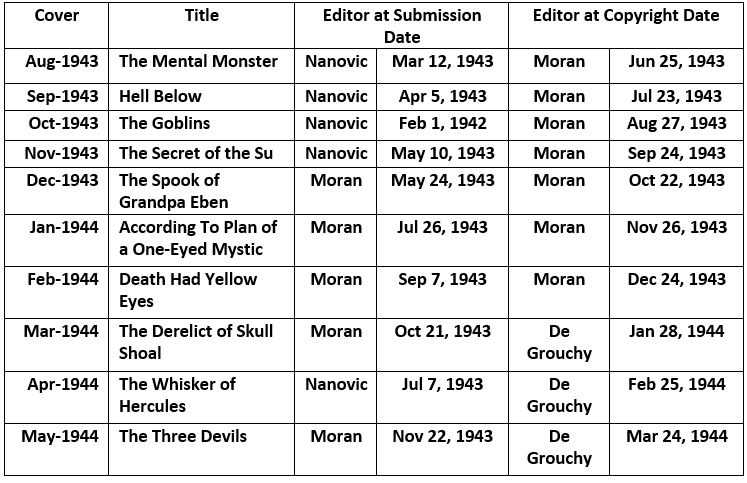
We know John Nanovic left Street & Smith in mid-July of 1943. I think we can safely attribute the August 1943 issue of “The Mental Monster” which was published on June 25, 1943, to Nanovic as Editor. The question is when did Nanovic’s editorial fingerprint end? Without more information, it is impossible to know the exact timeline of editorial changes. The table below shows pertinent information relating to dates and titles. Copyright dates come from the Library of Congress. Submissions dates are based on the information provided by Paul Bonner and compiled in Duende #2 by Will Murray. “The Pharoah’s Ghost” was submitted on December 20, 1944. Does that fall under Moran or De Grouchy? I lean toward De Grouchy as I don’t see Moran doing much work on this story even if he was still in the Street & Smith offices.
January 11, 1944 – William De Grouchy writes to Lester Dent explaining he has taken over Doc Savage and The Shadow. De Grouchy notes that Mr. Grammar and Mr. Ralston hope that he will reinvigorate sales of Doc Savage and The Shadow. This hope is based on De Grouchy’s work with the comics.
January 12, 1944 – Lester Dent writes William J. De Grouchy sending him an outline on a new story. Dent also remarks that Moran had him he was leaving Street & Smith. Dent described Moran as “going out into the cold-cold world.’
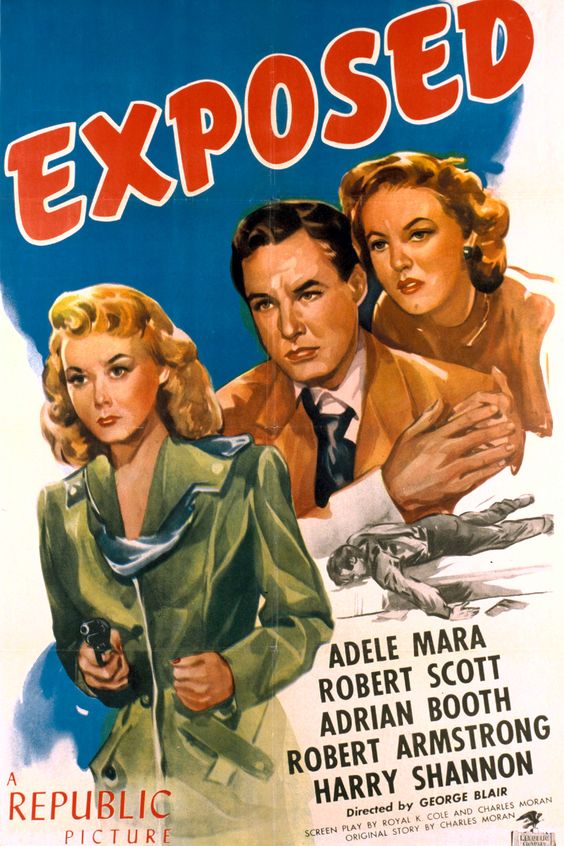
Charles Moran’s name next appears as the screenwriter for the movie, Exposed, released on September 8, 1947. This was a Republic Pictures feature with a female detective, murder, and secret experiments. His obituary also notes he did work for Skirball-Manning Productions.
Moran next shows up working for The Arizona Republic newspaper in May 1949. An article in the April 17, 1950, edition of The Arizona Republic lists Charles Moran as a Republic Staff Correspondent. Charles Henry Moran is living in Phoenix, Arizona, in 1951. He and his wife Rosalind reside at 544 East Adams. Moran works as the Sunday Editor for The Arizona Republic. The last found article by Moran in The Arizona Republic appeared on March 9, 1952.
The Arizona Republic published an article on the death of Charles Moran dated April 8, 1952. He had been ill from a series of strokes and suffered a third which led to his death. Other papers listed as former employers included the New York World, the New York World-Telegram, and the Newark Star Eagle. He was divorced at the time of his death. He died on April 7, 1952, in Port Chester, New York, at the age of fifty-one.
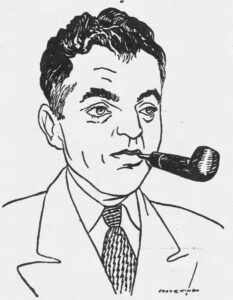
Charles Moran – 1952
There is one final mention of Charles Moran. Gerald H. Smith died in 1955. Four years later Charles Moran’s name pops up again in a tax court case brought on by Virginia Smith, the widow of Gerald Smith. The case mentions that Gerald Smith had advanced Charles Moran $10,000 for a biography Moran was going to write about Ormond Smith and the history of Street & Smith. Moran never completed the work. The IRS did not like the idea of the deduction for the fee, hence the court case. The book Gerald Smith wanted was finally published in 1955. Quentin James Reynolds authored The Fiction Factory: Or From Pulp Row to Quality Street: The Story of 100 Years of Publishing at Street & Smith.
The information presented here came from research using Newspapers.com, Ancestry.com, and Wikipedia. Information from correspondence came from the Lester Dent collection at University of Missouri in Columbia with special thanks to Ms. Tatyana Shinn, PhD, Assistant Director.