
So, just who was Meander Surett? Very often it seems, characters in the Doc Savage stories were made in part of whole cloth culled from the news and science magazines. There are three individuals who stand out as loud proponents of spiritualism. Thomas Edison (1847-1931), A. Conan Doyle (1869-1930), and Sir Oliver Lodge (1851-1940).
Meander Surett is modeled primarily on Thomas A. Edison. There are a few clear parallels that make this the strongest match:
– Electrical pioneer who “disappears” into private research. Surett is described as ranking almost with Marconi, pioneering ultra-short-wave radio and cosmic-ray theory, then vanishing for years into a secret desert laboratory. Edison, late in life, largely withdrew from public invention into private experimental work.
– The B. C. Forbes interview with Thomas Edison about the “spirit phone” (in which Edison said he had been “at work for some time building an apparatus to see if it is possible for personalities which have left this earth to communicate with us”) was published in 1920 in an October issue of The American Magazine.
– The “spirit radio” / static translator. The entire premise of Surett’s device—that ordinary radio static contains messages from the dead that can be translated by a sensitive electrical apparatus—directly echoes the popular (and heavily mythologized) stories circulating in his final decade about Edison working on a “spirit phone” or instrument to detect surviving personalities.
– Materialist skepticism mixed with experimental curiosity. Like Edison, Surett is portrayed as a hard-headed scientist who rejects ordinary mediums and séance tricks, yet is willing to pursue the question of survival with laboratory instruments. The novel even has Surett’s letter, and the newspaper coverage explicitly invokes Edison’s earlier work as the starting point for the research.
– Tragic end tied to the invention. Surett is poisoned by people who want his device, and his mind is shown as damaged by isolation and illness. While Edison did not die that way, the public image of the aging inventor brooding over life, death, and communication with the beyond supplied the emotional and scientific coloring Dent needed. Dent also called up Thomas Edison as a candidate for reanimation in in “Resurrection Day.”
No other contemporary scientist fits as cleanly. Sir Oliver Lodge was a true believer in spiritualism and mediumship, not a desert-isolated inventor of a mechanical translator. Conan Doyle was an advocate, not an electrical experimenter. Marconi and other radio pioneers lacked the specific “spirit communication” association that was attached to Edison in the popular press of the period.
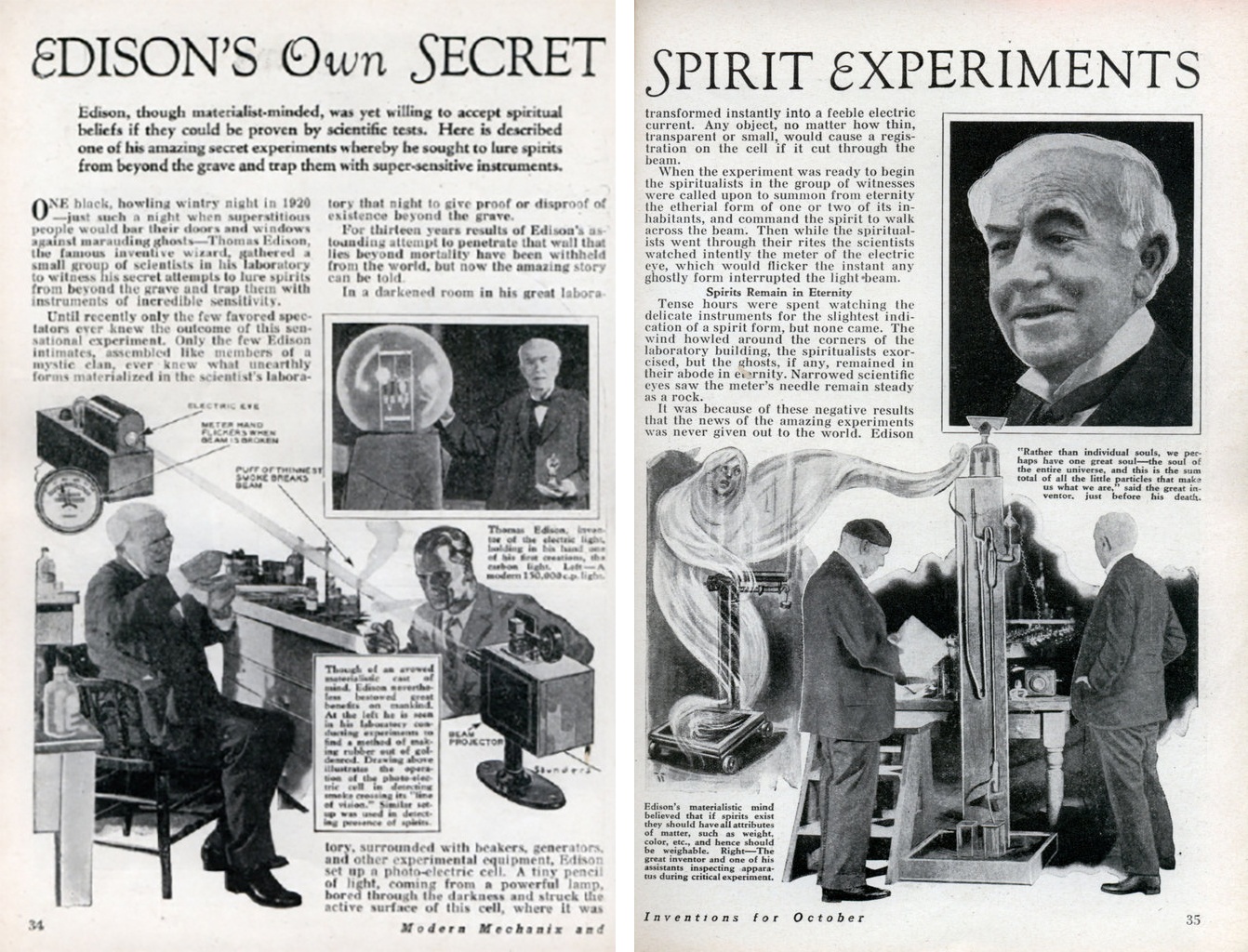
Modern Mechanix – October 1933