
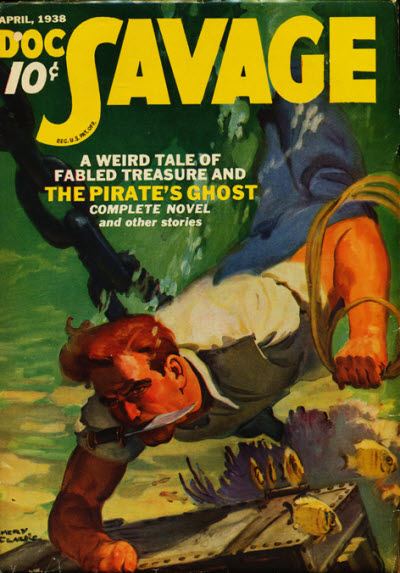
1938-04 The Pirate’s Ghost
Cover Date: April 1938
Volume 11 #2
Copyright Date: Friday, March 18, 1938
Author: Lester Dent
Editor: John Nanovic
Story Length: 41,874 words
WHMC: The collection contains 15 folders for this story, f. 476-490
Recurring Characters. The entire Iron Crew are all present in this story. Both pets also appear but only in cameo roles.
TABLE OF CONTENTS
“The Pirate’s Ghost” by Kenneth Robeson
“Boss of Black Bayou” by Wallace Brooker
“Treasure Hoard” by Harold A. Davis
“Jungle Menace” by William G. Bogart
Doc Savage Club
You Always Win
Modern Times
The Gods Speak
Science in its Stride
Civilization
From Our Readers
In the heat-seared wastes of Death Valley, young cowboy Sagebrush Smith stumbles upon the dying electrical genius Meander Surett and his hidden laboratory among prehistoric ruins. Surett, long vanished from the scientific world, entrusts Sagebrush with a heavy vault-steel chest and a desperate mission: deliver the box—and what it contains—to his daughter Sally in New York and to the legendary Doc Savage. He claims the chest holds a discovery that will change the course of mankind. Unknown men have already tried to steal it; one lies buried nearby.
Sagebrush barely escapes Death Valley with the chest before Hoke McGee and the ruthless Lazy Y outfit attempt to seize it. The chase draws in Doc Savage and two of his aides, the apish chemist Monk Mayfair and the dapper lawyer Ham Brooks. Doc examines Surett’s laboratory and confirms the scientist was poisoned, not killed by cancer as he believed, and that his claims of being watched were not entirely the product of a dying mind.
The contents of the chest are soon revealed to the world as Meander Surett’s “Static Translator”—a device said to turn ordinary radio static into messages from the dead. A striking blonde who claims to be Sally Surett, working with the smooth-talking New York lawyer Everett Everett Barr, stages dramatic public demonstrations. The machine appears to free an innocent woman from prison, expose a murder, and even deliver messages from the shade of a long-dead Spanish pirate, Captain Scuttle, who offers to reveal the location of a vast treasure.
Doc Savage publicly declares the device worthless, yet the demonstrations continue to produce results that seem impossible to fake. Newspapers turn against him. Meanwhile, the real Sally Surett remains missing, and Doc’s men uncover a web of carnival grifters, staged “spirit” messages, and carefully planted evidence. The plot centers on a chartered steamer bound for Scorn Island, where Barr and Hoke McGee intend to stage a final, deadly performance involving a hundred cases of dynamite.
When the ship reaches the island, Doc and his aides move to stop the scheme. In a narrow-margin confrontation aboard the aging steamer, Doc must prevent the planned explosion, free the real Sally Surett and his captured men, and expose Barr’s long-running confidence game—one built on public hunger for contact with the dead and the promise of a hundred-million-dollar pirate hoard. The adventure ends with the chest recovered from the deep and the recognition that, while Meander Surett’s mind had failed him in the desert, the scientific path he had been exploring was not entirely without promise.
There are touchstones throughout the series. These are the characteristics that are key elements of a Doc Savage story. Readers of “The Pirate’s Ghost” encounter almost every one of them.
-Doc’s flake-gold eyes with their hypnotic quality
-His powerful and cultured voice
-Doc Savage’s unique trilling
-Anaesthetic globes
-Machine pistols with mercy bullets and explosive rounds
-Invisible messages visible only under ultraviolet light
-The gyroplane,
-The paralyzing nerve pinch
-The Fortress of Solitude is mentioned
-Smoke bombs
-Doc’s secret source of wealth appears as a mystery to the criminal gang
-The bullet-proof chain mail
-Doc’s photo-electric version of night vision goggles.
There are some differences from earlier stories. The old-style ultraviolent lantern that resembled the old fashion magician’s magic lantern has been replaced with a small flat case that has a wind-up generator built into it. In similar fashion, the previously described bullet-proof chain mess alloy under garments have been replaced by cloaks made of the same material.
There is also more dialogue for Doc Savage than seems normal. Another interesting point is the scene where Doc Savage borrows Monk’s supermachine pistol with explosive rounds to demolish parts of the Lazy Y ranch. It would seem more normal if Doc had simply told Monk to use the pistol himself with a very short and succinct dialogue such as “Discourage them.”
Another striking difference is the detailed description of the night vision googles. This is probably the most detail about this item readers have gotten throughout the series.
“photo-electric mechanical devices for seeing in intense darkness with the aid of invisible wave lengths of light.
He was using a projector of light rays outside the visible spectrum, and a complicated viewer device for his eyes—a contrivance of mirrors which received a semi-fluorescent picture formed by impact of the reflected “black light” on a chemical coating which retained the image long enough for it to be turned and shown to the bronze man’s eyes.”
The Death Valley location rings back to Lester Dent’s 1932 trip to the area where he met Death Valley Scotty.
This story was submitted to Street & Smith on Friday, October 22, 1937. The Dent papers at Missouri State University in Columbia show fifteen folders in the manuscript collection. Interestingly, the collection also includes fifteen folder for “The Pirate’s Ghost.” This is a strong indicator of a major rewrite by Dent.
With a folder count of fifteen, this ranks this story in third place along with “Dust of Death” (October 1935) which also was initially written by Harold A. Davis and “The Red Terrors (September 1938). Some other hands may have touched the manuscript before Dent massaged it into the printed version.
Censorship: Street & Smith was generally careful to avoid using the actual names of belligerent nations in its fictional publications. But that was not a steadfast rule as we can see in “The Pirate’s Ghost.” Here Ham disguises himself as an Italian reporter newspaper so that he might be on hand for Everett Everett Barr’s press conferences. Ham cuts a ridiculous figure carrying an umbrella and wearing galoshes even though the likelihood of rain is nonexistent. Part of this novel attire can be attributed to the sartorial perfection enjoyed by Ham in his normal life. Dressing him up like this adds a comedic element to the story. Added to that is a striking stereotypic Italian vocabulary.
His colleagues do not hold this Latin reporter in high esteem. Then we learn that Ham’s character has a connection to someone in the news. He possessed credentials saying he represented a paper owned by Premier Mussolini of Italy, and no one suspected otherwise. So in a way, El Duce is getting a big raspberry. Why shovel this disrespect at a foreign leader? The fact was that Italy was then in the process of a big land grab and conquering Ethiopia. Poison gas was being used against the Ethiopian people. It was airplanes and machine guns against essentially defenseless people.
The idea of spiritualism was on the wain. But only a few years earlier in 1930, Time Magazine noted that Arthur H. Lynch’s Science & Invention safely had publicly offered a $21,000 prize for anyone who could provide solid proof of spiritualism
Spiritualism: Spiritualism is a very significant concept in The Pirate’s Ghost where we encounter a genuine “spirit radio”.
Meander Surett’s name is mentioned in the same breath as Thomas Edison. We can only conclude that he is deserving of the same respect given to the world renowned Edison. And that respect extends to Surett’s ideas. Static is the culprit as it turns out. No one can adequately explain it. Surett’s device becomes known as a “static translator”.
Public opinion goes over big for the idea. One newspaper in particular endorses the idea to such an extent that they equate it with the Rapture in its newsworthiness. That is to say they use news type that was reserved for that particular event. That soothsayer word appears again as Doc explains he is not “clairvoyant” and hence incapable of knowing the gang’s plans. The entire thing turns out to be part of an elaborate “carney ” hoax. In this way Dent is condemning the shysters and crooks that make false claims about supernatural abilities. But the fundamental concept is somewhat exonerated in the final analysis.
Concluding the story we learn that Doc still thinks there is some validity in Meander Surett’s work. He tells the genuine Sally Surett that this scientific field is virtually uncharted territory. Doc further affirms it is entirely possible that her father could have been successful in his work under different circumstances. It is something he intends to tell the newspapers.
Monk ridges Sagebrush Smith pretty hard with a litany of cowboy pejoratives that give some insights into young Lester Dent’s early reading material.