
Cover Date: March 1944
Volume 23 #1
Copyright Date: Friday, January 28, 1944
Author: Lester Dent
Editor: Charles Moran
Story Length: 33,370 words
WHMC: The collection contains eight folders for this story, f. 884-891
Recurring Characters: Monk, Ham, and Renny are present in this story. There is no explanation about the whereabouts of Long Tom and Johnny.
Western Historical Manuscript Collection: The original title was “Skull Shoal.”
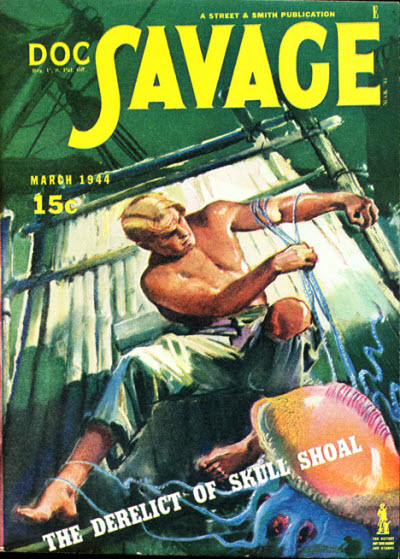
TABLE OF CONTENTS
“The derelicts of Skull Shoal” by Kenneth Robeson
SHORT STORIES
“Submarine I-26” by Carl Jacobi
“Last of the Goths” by R. A. Emberg
“Highway Cop” by William G. Bogart
SHORT SHORT STORY
“Eddy of War” by John Scott Douglas
DEPARTMENTS
“All in One Word”
Disguised as an ordinary seaman, Doc Savage is aboard the converted liner Farland when a mysterious dog-howl is heard at sea. Moments later the ship is “torpedoed.” Explosions and fires follow; the crew abandons her. Doc, Monk, Ham, and Renny remain aboard and discover the vessel is not sinking. The attack was staged. The Farland is one of several cargo ships that have vanished after apparently being torpedoed; their crews are never found.
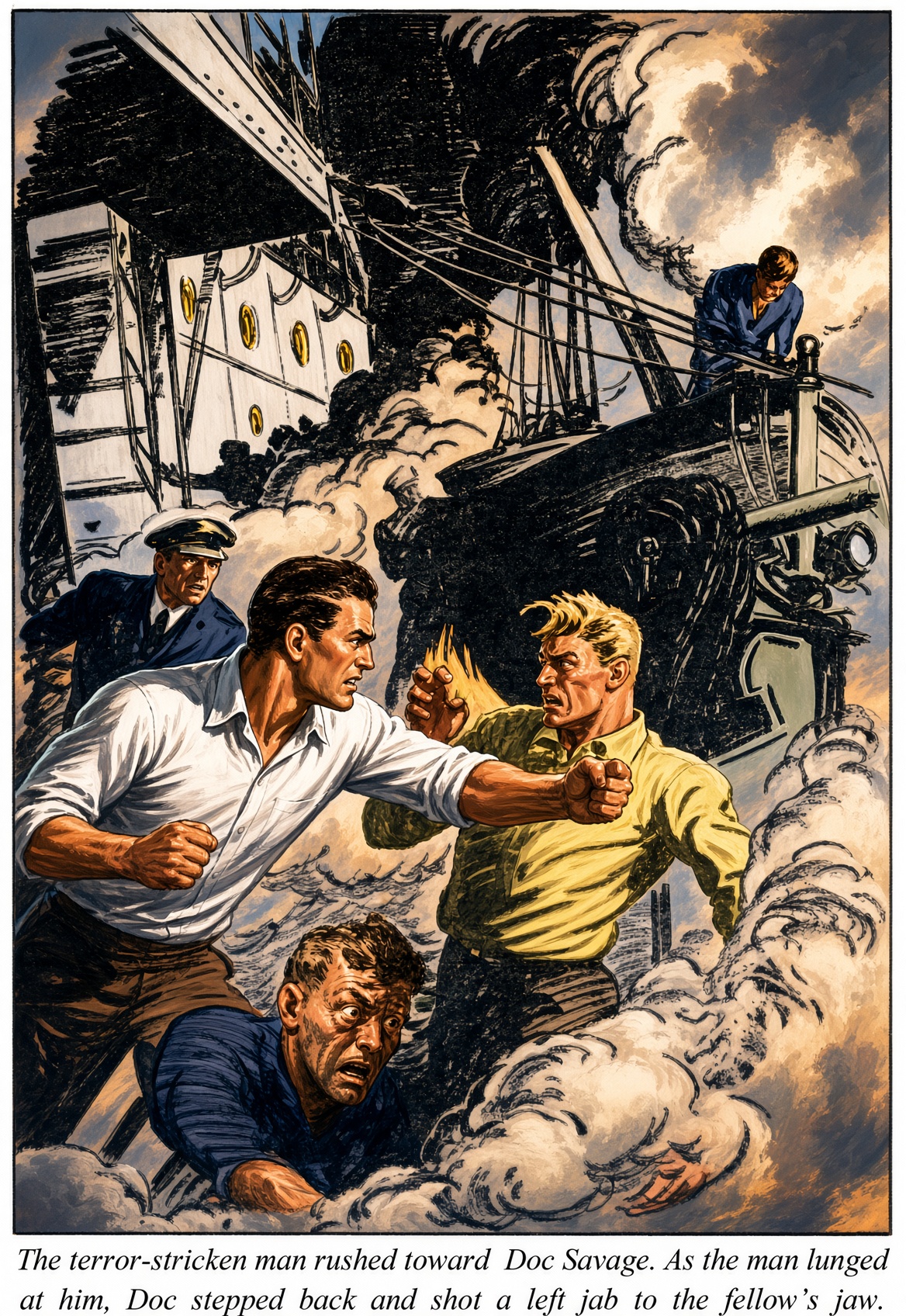
The trail leads to a remote Caribbean reef called Skull Shoal, where two groups are stranded: American seamen under Lieutenant Commander Kelly, and a band of Amazonian natives who had been captured by pirates. The pirates, led by the theatrical Woll and the practical Rogers, have been seizing gold shipments bound for Italy. They use a dog-howl as a signal, force crews off the ships, and tow the vessels to the reef. The natives, armed with curare-tipped weapons, have been fighting both the pirates and the stranded sailors.
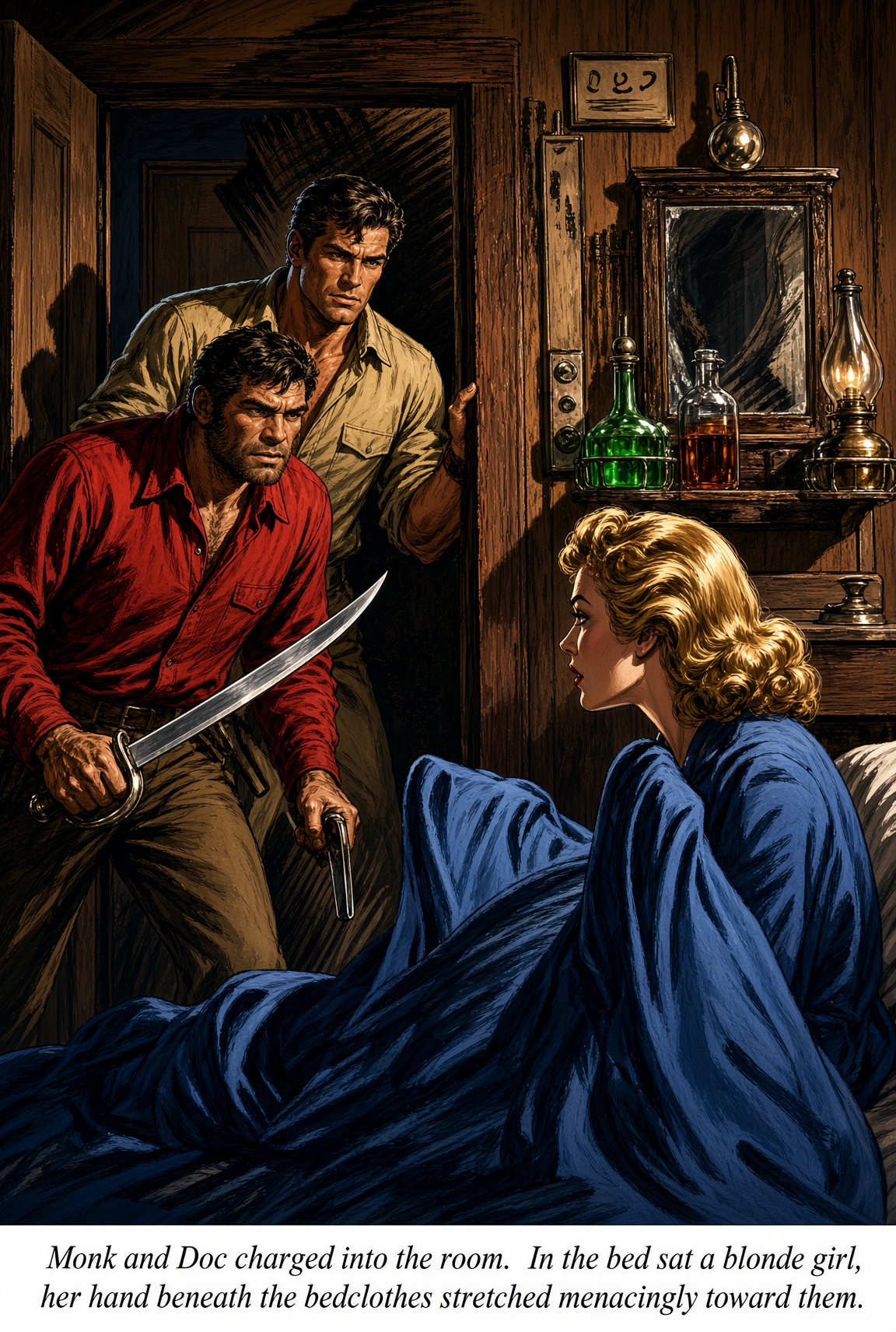
Doc learns the natives’ dialect and persuades them to cooperate. Using oil-smoke rafts and coordinated password signals, the combined force boards the pirates’ yacht at night. In the smoke-filled battle the pirates are overcome; Woll is taken by sharks. The stolen gold is recovered. The natives are promised passage home, and the Farland and other ships are secured. Monk, as usual, manages to miss the formal order to hold the natives back and arrives after the fighting with a collection of black eyes and missing clothing.
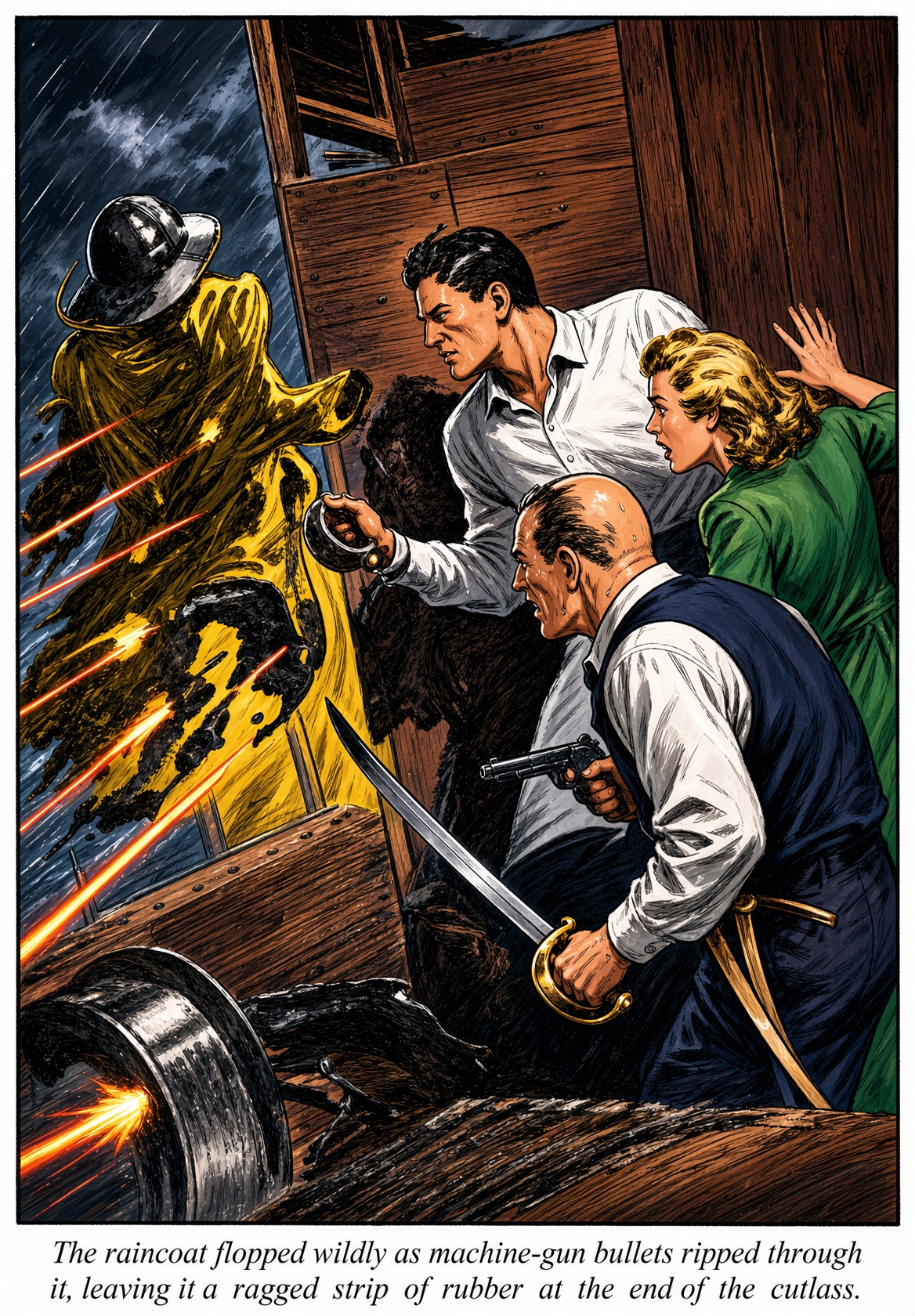
Lester Dent inserts a bit of morse code into the story. It is noted that the sender does not know the code and is pulling his letters from a chart as he transmits.
Doc suffered fractured skull?
This may be one of the best-written Doc stories I have ever read. The writing was very good.
The story shares several elements with “The Sargasso Ogre.”
In this tale, ships are hijacked to a remote location where they are ransacked.
Castaways from the wrecks populate the ghost yard of wrecked ships.
There is a physical fight between Doc and the pirate leader.
There is a similarity between the drug thimbles Doc uses in earlier story and the curare tipped arrows used by the natives in this story.
This time Doc Savage has a tough go of it. He is no longer the larger-than-life figure from the thirties. Rather he is more like a regular tough guy who is also suffering the after-effects of a severe head wound. Doc wins but is left breathless. Dent is pulling a funny here.
Given that this story shares many traits with The Sargasso Ogre it is especially interesting to look at Doc’s opponent, ex-Hollywood movie-man, Samuel Woll. He is a fat little man with funny ears, extremely large feet, and a stomach described as a watermelon.
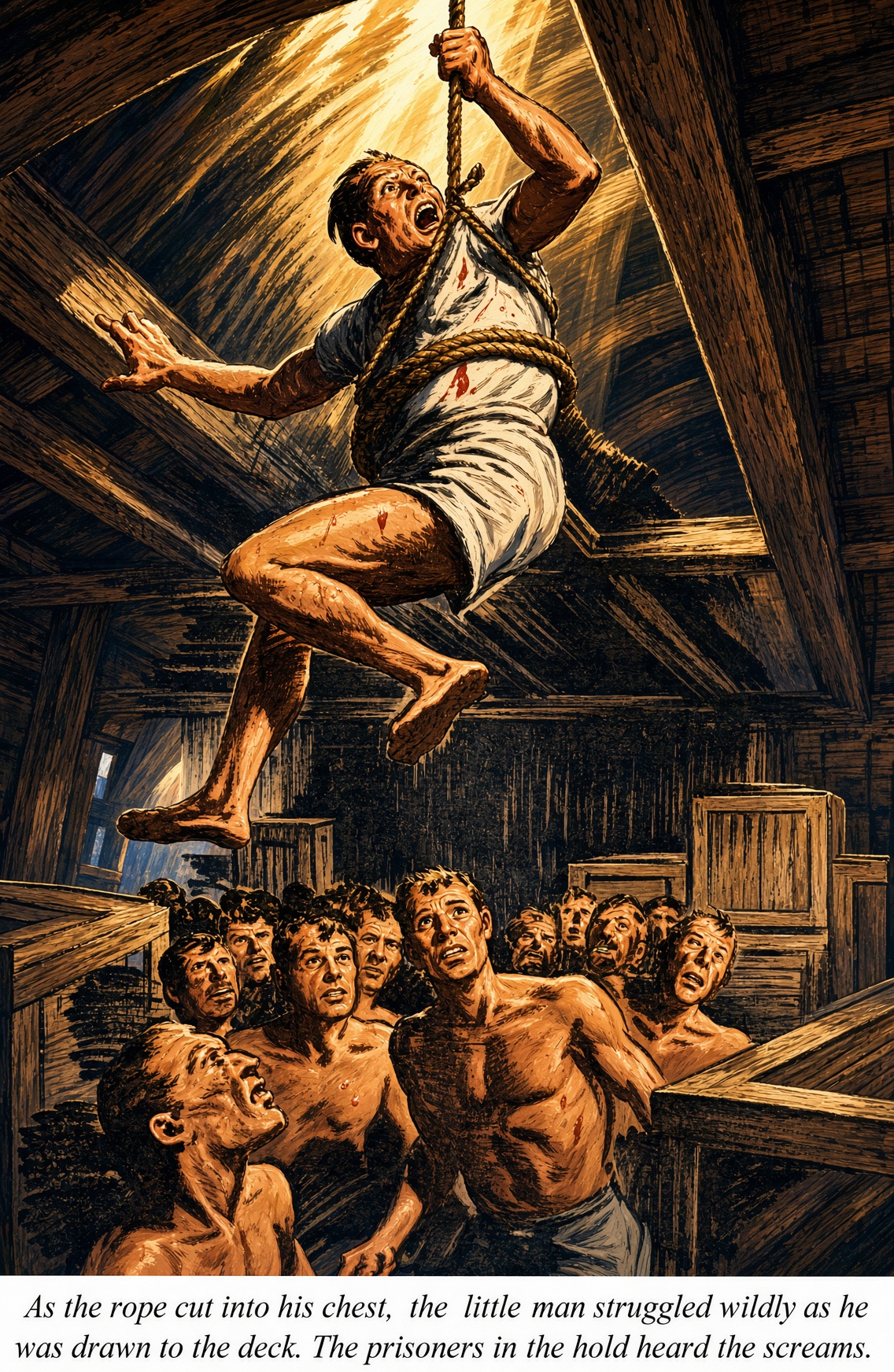
In the fight, Doc lands a blow to Woll’s stomach. The little man simply takes it and wraps around the bronze man like a constrictor. Doc finally overcomes Woll, but it is a difficult fight. Part of this could be attributed to Doc’s head injury. The rest is Lester Dent setting up a foe the exact opposite of Jacob Bruze. It’s a good joke.
Doc Savage is struck hard enough to lose consciousness, wakes with blood matted in his hair, multiple scalp welts, and severe pain that makes him check for fractured-skull symptoms. He remains functional but later notes residual weakness from “the rap over the head.” The story treats it as a serious but survivable trauma rather than a minor bump; classic concussion signs (loss of consciousness, post-traumatic headache, temporary cognitive fog) are present.
Series Continuity
However, there are other problems with consistency. The story comments that piracy just doesn’t exist anymore except for some on the China coast and that was twenty years ago. What about” Pirate of the Pacific,” “The Sargasso Ogre,” and even “Pirate Isle?” The last story was less than two years before.
A comment is made about Doc lying in wait until the ship makes its destination. We are told it is something he has never done before, and it is something he doesn’t like doing. That wasn’t the case in two stories I recall offhand – “Mystery Under the Sea” or “The Motion Menace.”
Gadgets and Gimmicks
-Disguise kit: Bronze hair dyed black/gray, skin dyed ruddy, tinted “contact” lenses to change eye color from flake-gold to dull brown, plus a slight slouch and limp. Identity as “Bill Doyle, A.B. (Able Bodied Seaman)” with forged papers.
-Contact-lens remover: Small suction-cup gadget (lost after the initial attack).
-Code phrase: “Three blind mice” — opens Captain Davis’s sealed orders naming Doc as superior officer.
-Ship systems: Interphone/public-address system linking bridge to all parts of the vessel; signal gun firing parachute flares.
-Improvised combat gear: Hatch-lid rafts, shuffleboard stick used as paddle/oar, fuel-oil smoke pots in containers (kettles, buckets, extinguishers) to create a smoke screen, wooden doors/crating/planking for additional rafts.
-Password system: Rotating battle passwords (“Damn!”, “Hitler!”, “Fooey!”) so attackers can identify friends in the dark and smoke.
-Curare: Native arrow/spear poison (tips of sharp sticks) used as a threat and potential weapon.
-Dog-howl signal: Siegel’s distinctive howl used both as a personal habit and as a pirate signal.